
Residential only
Houses, not warehouses
7 days a week
8am – 8pm, including weekends
Measured inspections
Elevation readings, not guesses
Written scope & warranty
Terms before work begins
Slab-on-grade construction is the standard across Pasadena and the surrounding Gulf Coast suburbs. The concrete is poured directly on prepared soil, so the slab is only as stable as the ground beneath it — and that ground is expansive clay that changes volume with moisture.
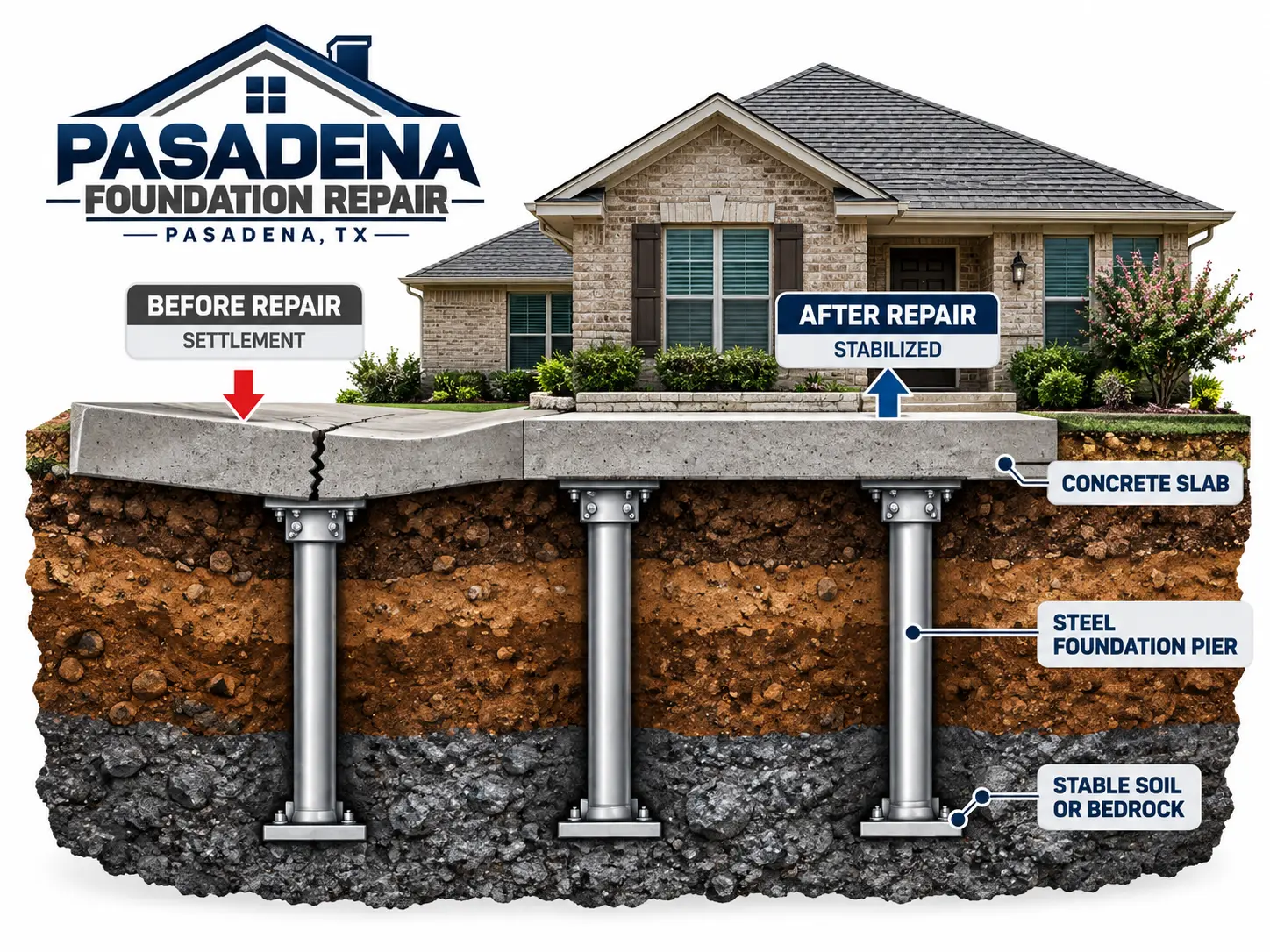
Slab repair is not about patching concrete. It is about transferring the weight of the affected part of the house onto supports that reach deeper, more stable material, then bringing elevations back into a safe range without causing new damage.
How we diagnose a moving slab
We take elevation readings throughout the interior to map the shape of the slab, then compare that map to what the walls, brick, and floors are telling us. A slab that has dropped at one corner behaves very differently from a slab that has heaved in the center, and the repair plans are opposites.
We also look for water. If readings show a localized low or high area near a bathroom, kitchen, or laundry, a plumbing test may be warranted before any piers are installed. Repairing a slab over an active leak is money spent twice.
Steel piers vs. concrete pressed pilings
Steel piers are driven in sections with hydraulic force until they meet load-bearing resistance, which makes them a good fit where the depth to stable strata varies or is significant. Concrete pressed pilings are segmented cylinders pressed into the clay to a tested depth and are a long-proven, cost-effective option in much of Harris County.
We will tell you which one we recommend for your house and why, including the trade-offs in depth, cost, and access. Both are installed from the exterior perimeter in most cases, with interior supports added only when readings require them.
What the repair day looks like
Access holes are dug at each planned support location, usually along the perimeter beam. Supports are installed and load-tested, then the crew lifts in small, monitored increments so trim, brick, and drywall move back gradually. Once elevations are within tolerance, the supports are locked off, holes are backfilled and compacted, and the site is cleaned.
- Landscaping and hardscape are protected and photographed beforehand
- Lift increments are monitored to limit new cosmetic cracking
- You receive documentation of pier locations and final elevations
- Cosmetic repairs (drywall, paint, tile) are discussed up front, not assumed
Concrete foundation repair in Pasadena: what to compare
If you are collecting bids for concrete foundation repair, compare the inspection and the scope, not just the total. Ask whether elevations were actually measured, how many support points are included, what happens if more are needed mid-project, whether drainage was evaluated, and what the warranty covers and transfers to a future buyer. Two quotes with the same price can describe very different projects.
Questions homeowners ask
Slab Foundation Repair FAQs
Sometimes. A hairline crack with no elevation difference and no wall damage may only need monitoring and drainage correction. Piers are for measured settlement, not for every crack.
More answers on our foundation repair FAQ page.
Areas we serve
Pasadena and Nearby Communities
Our shop is on E Southmore Ave in Pasadena, and most of our work is within a 25-minute drive. Have your 5-digit ZIP code ready when you call so we can confirm availability for your street.
Service availability
Get a Residential Foundation Quote
Call and tell us what you're seeing at the house. We'll confirm service availability, schedule an inspection that works around your week, and put everything in writing. Open 7 days a week, 8am–8pm.
- Residential homes only — slab and pier & beam
- 825 E Southmore Ave, Suite 193, Pasadena, TX 77502