
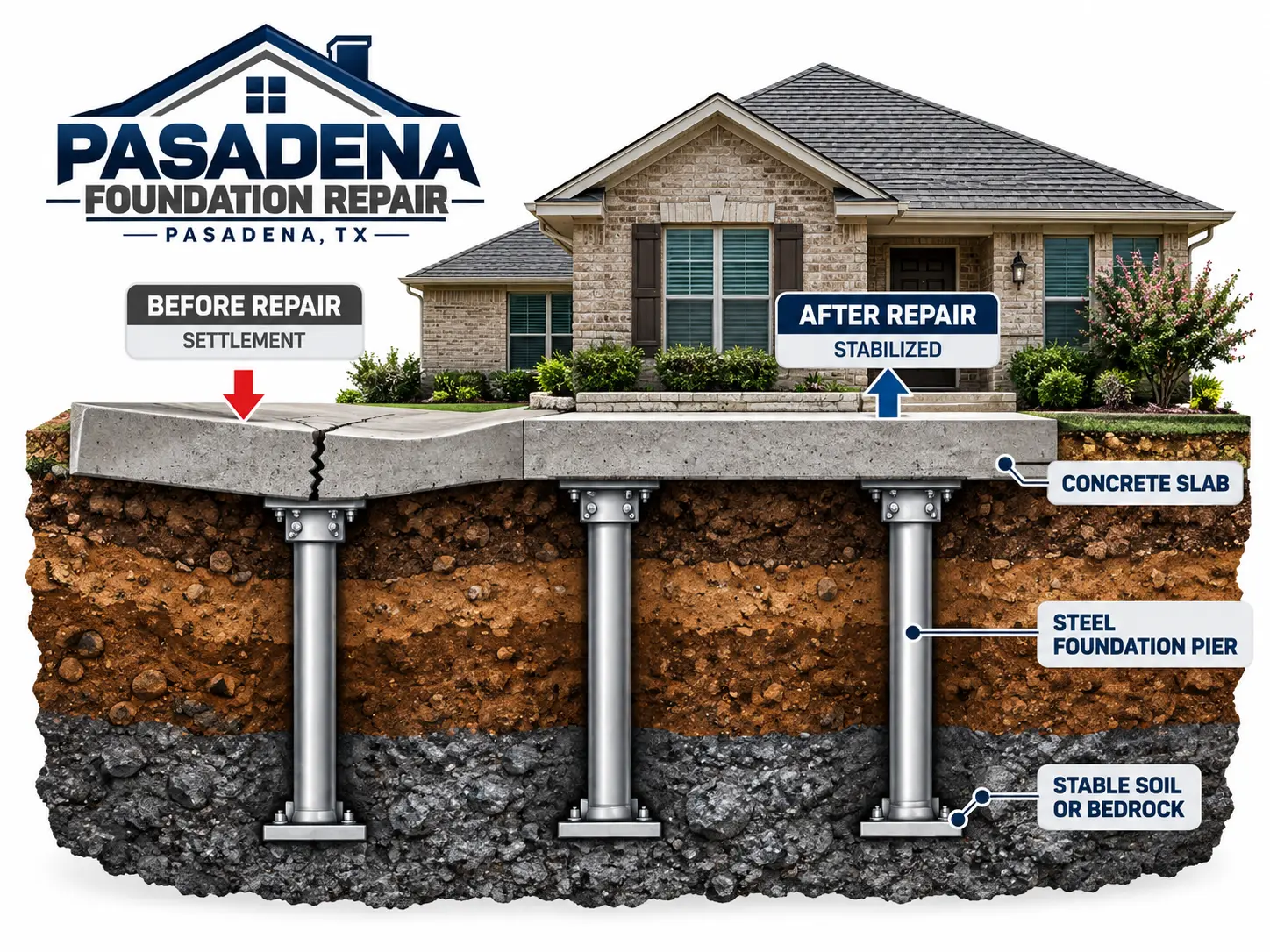
Almost every slab foundation problem in Pasadena traces back to soil moisture. The concrete itself is rarely the failure — the ground under it changes volume, and the slab has no choice but to follow.
Here is what is actually happening beneath a Pasadena home, and why the cause matters as much as the symptoms.
Expansive clay: the main driver
The Gulf Coast clay under Pasadena contains minerals that absorb water and swell, then release it and shrink. The volume change is significant — enough to lift or drop the edge of a slab by an inch or more across a season.
The perimeter of your slab feels this first because it is closest to the weather, the landscaping, and the downspouts. The center of the slab is insulated by the house above it and stays more stable, which is why classic settlement shows up as a dropped edge or corner.
Our rainfall pattern makes it worse
Southeast Texas does not get steady moisture. We get several inches in an afternoon, then weeks of heat with nothing. Saturated clay followed by hard drying is the most aggressive cycle possible for a slab, and it repeats every year.
This is why consistent perimeter moisture — not maximum or minimum — is the goal of any good drainage and watering plan.
Drainage and grading problems
Most homes we inspect have at least one drainage condition contributing to the movement.
- Downspouts discharging within a foot or two of the slab
- Soil graded flat or sloping back toward the house
- Flower beds with borders that trap water against the brick
- A/C condensate lines dripping at one spot year-round
- Sprinkler zones that soak one side and miss the other
- Patio or driveway slabs draining toward the foundation
Under-slab plumbing leaks
A leaking supply or drain line under the slab keeps a small area of soil soft and saturated while everything around it dries normally. The result is a localized low spot in the elevation map, often near a bathroom, kitchen, or laundry.
This is why an unexplained water bill increase, a warm spot on the floor, or a musty smell in one room is worth mentioning during an inspection. Installing piers over an active leak repairs the symptom and leaves the cause running.
Trees, roots and moisture demand
A mature tree can draw many gallons of water a day out of the soil in summer. When that tree is close to the house, it competes with your foundation for moisture and can cause the nearby clay to shrink faster than the rest of the perimeter. Removal is not always the answer — root barriers and targeted watering often are.
Construction history: fill and additions
Additions, converted garages, and homes built on graded fill can settle independently of the original structure if the fill was not properly compacted. When elevation readings show a clean break at the line where an addition meets the house, that is usually what happened.
The short version
Fix the cause and the repair lasts. Support the structure without addressing water, and the soil goes right back to work.